
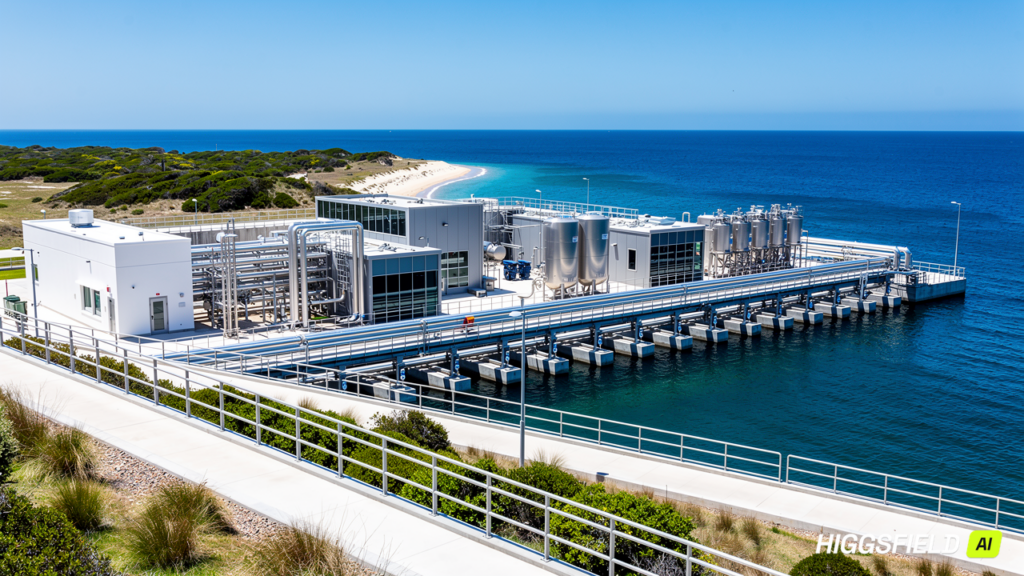
What Is Seawater Desalination and How Does It Work?
Seawater Desalination Systems Explained: Classes, Capacities, and Applications begins with a simple engineering premise: ocean water contains far too much dissolved salt for direct human consumption or industrial use. Seawater desalination systems are engineered technological solutions built to remove dissolved salts and minerals from ocean water, producing freshwater suitable for drinking, industrial utility, and agricultural blending. The separation processes involved rely on either pressure or heat to force a physical split between pure water molecules and the salts, minerals, and organic matter carried in the source water. An authoritative overview of these methods is available through the USGS Water Science School, which documents the range of desalination approaches used worldwide.
The fundamental goal of any desalination facility is transforming hypersaline feed water, typically carrying around 35,000 mg/L of Total Dissolved Solids, into high-purity product water suitable for potable or industrial standards. Salt removal at this scale requires carefully staged treatment rather than a single filtration pass.
Core Operational Steps in Seawater Treatment
Intake and screening collect raw seawater through open ocean intakes or subsurface beach wells, filtering out macro-debris while limiting harm to aquatic life. Pretreatment follows, using media filtration, microfiltration, or ultrafiltration alongside chemical dosing to strip out suspended solids, turbidity, and organic precursors that would otherwise foul downstream membranes. The main separation phase applies either high-pressure membrane force through reverse osmosis or thermal evaporation through distillation, splitting the feed stream into high-purity permeate and concentrated brine. Post-treatment and stabilization then reintroduce minerals such as calcium and bicarbonate for pH balance, corrosion prevention, and final disinfection before the water enters distribution.
What Are the Main Classes of Seawater Desalination Technologies?
Global desalination technology falls into two primary classes: membrane separation and thermal evaporation. The U.S. Department of Energy guide on desalination basics benchmarks these categories against their energy classifications and core operating definitions. Seawater Reverse Osmosis, commonly abbreviated SWRO, is the dominant membrane-based process, relying on semi-permeable spiral-wound polyamide membranes that operate under hydraulic pressures between 55 and 80 bar to force pure water through while rejecting dissolved salts.
Multi-Effect Distillation and Multi-Stage Flash represent the thermal branch, evaporating seawater and condensing the resulting steam across successive stages. These processes suit facilities with access to waste heat or integration alongside power generation plants. Beyond these two dominant classes, secondary and specialized methods exist for niche cases: Electrodialysis moves ions across charged membranes under an electric field, Forward Osmosis draws water using an osmotic gradient rather than applied pressure, and Thermal-Membrane Distillation combines heat and hydrophobic membranes for high-salinity or brine-concentration tasks.
Technical Comparison: SWRO vs. Thermal Systems
SWRO is electricity-driven, carries a comparatively low energy requirement per cubic meter produced, remains sensitive to feed water fouling, and occupies a compact footprint. MED and MSF systems are thermal heat-driven, consuming more energy unless paired with power generation, but they resist biological fouling well and yield distillate purity below 10 mg/L TDS. Hybrid and specialized configurations combine thermal heat recovery with membrane stages, aiming to raise system recovery rates while cutting operational waste.
How Are Seawater Desalination Systems Classified by Capacity?
Classifying plant capacity by daily freshwater output, expressed in cubic meters per day, matters for engineering design, footprint planning, and capital expense forecasting. A facility sized for a resort differs entirely in equipment, staffing, and redundancy needs from one built for a metropolitan grid.
| Capacity Band | Output Range (m³/day) | Typical Application |
|---|---|---|
| Micro Capacity | Under 10 | Private vessels, emergency stations, offshore research craft |
| Small Capacity | 10 to 500 | Eco-resorts, coastal hotels, small island communities |
| Medium Capacity | 500 to 20,000 | Industrial facilities, municipal island grids, agricultural complexes |
| Large Capacity | 20,000 to 200,000 | Regional municipal utilities, heavy industrial hubs |
| Mega Capacity | Over 200,000 | National infrastructure for major metropolitan centers |
Nameplate capacity refers to the theoretical operational yield calculated at baseline temperature and salinity, while net operational capacity reflects the actual delivered water after downtime, clean-in-place cycles, and intake fluctuations are factored in. Sizing logic for any project should account for peak water demand, a storage buffer factor, and N+1 pump or membrane redundancy so that a single component failure does not interrupt supply.
What Are the Key Applications Across Different Sectors?
Municipal drinking water applications supply coastal cities facing aquifer depletion or saltwater intrusion with a reliable freshwater source independent of rainfall patterns. Industrial process water applications lean on desalination to produce ultra-pure boiler feed water, high-purity rinse water, and cooling tower makeup for power plants, refineries, and chemical processing facilities where mineral content must stay within tight tolerances.
Commercial and HoReCa applications give island resorts, isolated hotels, cruise ships, and coastal hospitality centers a degree of water autonomy that municipal connections cannot always guarantee.
You can explore the services through the website at the attached link: aquaphorpro.com.
Agricultural and specialized applications blend low-boron desalinated permeate into irrigation water for high-value crops sensitive to boron toxicity, along with remote livestock operations that lack access to fresh groundwater.
How Much Energy Do Desalination Systems Use and How Is It Managed?
Specific Energy Consumption, measured in kilowatt-hours per cubic meter, is the primary metric used to evaluate how efficiently a desalination system converts electrical input into freshwater output. Modern SWRO facilities equipped with current energy recovery infrastructure typically operate within a full-system SEC range of 3.0 to 4.0 kWh/m³. Energy Recovery Devices, particularly isobaric pressure exchangers and Francis turbines, capture up to 98% of the hydraulic energy contained in high-pressure reject brine and transfer it directly to incoming feed seawater, substantially lowering pumping demand.
Key drivers behind energy consumption include raw water salinity, ocean water temperature, the target recovery rate percentage, and the operating pressure required to push feed water through the membrane array.
Preventative Maintenance and Fouling Prevention
Operational fouling mechanisms include biofouling from bacterial growth, organic fouling, colloidal clogging, and mineral scaling caused by calcium sulfate or silica precipitation. Routine maintenance protocols involve automated backwashing, chemical dosing with antiscalants and biocide control agents, and periodic Clean-In-Place washes using acid and alkaline solutions to restore membrane flux and extend service life.
What Are the Environmental and Regulatory Considerations for Desalination?
Commissioning seawater desalination infrastructure carries environmental obligations tied to marine ecosystems and coastal habitats. The California State Water Resources Control Board FAQ document addresses marine life protection standards and intake regulation, offering a regulatory reference point for project planners.
Brine discharge, or concentrate, management strategies include multi-port diffuser systems, pre-dilution using power plant cooling streams, and engineered marine outfalls designed to prevent hypersaline layers from settling on the seabed. Raw water intake choices matter equally: open ocean submerged intakes require low-velocity caps and fine mesh screens to limit organism entrainment, while subsurface intakes such as beach wells or gallery intakes use natural seabed filtration to protect marine larvae before water even reaches the plant.
Air emissions and broader sustainability goals push many operators toward coupling energy-intensive desalination facilities with renewable power sources, including solar photovoltaic arrays, wind turbines, and wave energy installations, reducing the carbon footprint tied to continuous freshwater production.
What is the typical lifespan of a seawater reverse osmosis membrane?
Membrane life varies with feed water quality and maintenance discipline, but well-maintained SWRO membranes commonly operate for several years before replacement becomes necessary, with periodic Clean-In-Place cycles extending usable service life.
Can desalinated water be used directly for irrigation?
Desalinated permeate is often blended with other water sources for irrigation, particularly for boron-sensitive crops, since low-boron blending helps avoid toxicity while preserving the benefits of a stable freshwater supply.
Why do thermal desalination plants pair with power generation facilities?
Thermal methods such as Multi-Effect Distillation and Multi-Stage Flash rely on steam or waste heat, so integrating them with power plants allows shared infrastructure and recovered heat that would otherwise be discharged unused.
What determines whether a project needs a subsurface or open ocean intake?
Site geology, capacity requirements, and environmental permitting all influence intake choice, with subsurface options generally preferred where seabed conditions allow, due to their natural filtration benefits for marine larvae.
About the Business
AQUAPHOR Professional stands as a leading manufacturer of advanced commercial and industrial water purification systems, developing water treatment solutions engineered for a wide range of sectors, including industrial, commercial, agricultural, HoReCa, healthcare, and municipal applications. The company's engineering work centers on reverse osmosis technologies, ultrafiltration pretreatment systems, and modular skid designs built to perform reliably across demanding operational environments. Its approach to industrial water treatment emphasizes durable membrane development and energy-conscious system architecture, supporting clients who require dependable, large-scale purification capacity alongside manageable long-term operating costs.